


Wise Man of Water Project (WMW)
The Heart of the People, the Sage of Water
Organic Farming
Replenishing Groundwater

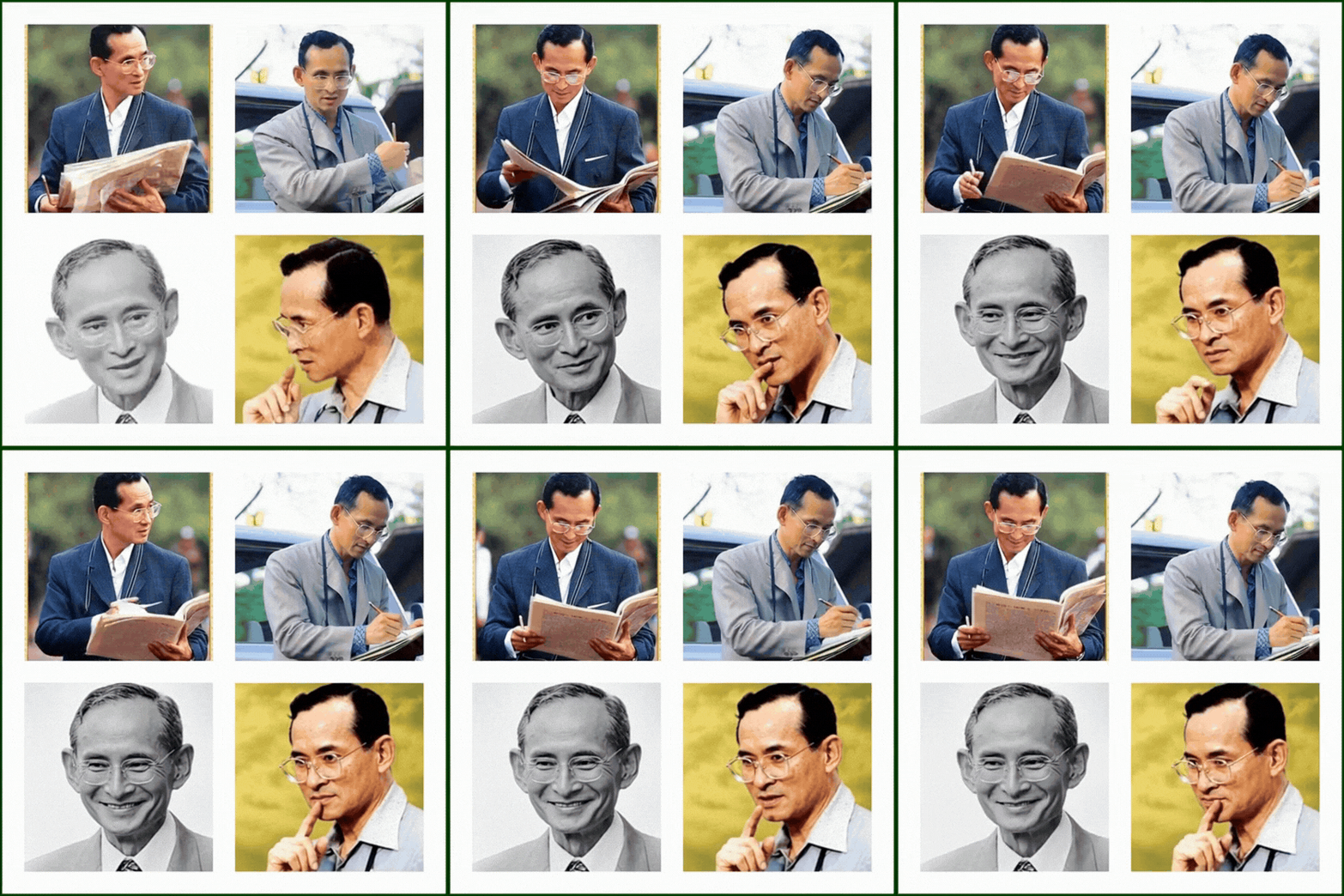
For Thai farmers and towards becoming the world's kitchen.
In short, the Organic Joint Farming Project for the King aims to support His Majesty's royal initiatives related to water, soil, and organic farming (OJFT).

Summary of Key Points of the "Organic Joint Farming for the King, for the Land of Thailand (OJFT) Phase 1" Project
And Overview of "The Heart of the People, Wisdom of Water" or Wise Man of Water (WMW) Project for Investors and Executives
Section 1. Basic Information and Vision
1.1 Project Name: Organic Joint Farming for the King, for the Land of Thailand (OJFT) Phase 1
1.2 Project Proposer: Vicharn Group (VG) and The SUN Academy (TSA), with Mr. Dulyawat Phuttakaya as CEO
1.3 Project Philosophy: Applying the royal initiatives of His Majesty King Bhumibol Adulyadej (Rama IX) in organic agriculture, water management, and groundwater recharge (sand reservoir).
1.4 Project Area: Approximately 50,000 rai in the Bueng Boraphet area, divided into two main parts: the WMW project (20,000 rai) and the MSC project (30,000 rai). Alternatively, this means designating two permanent reserved areas for organic farming for Thai farmer partners and three business areas for the major investor.
1.5 Major investors in the business model known as the Blue Heaven Model of the Maldives in Thailand (MIT) project will make significant investments in creating a paradise on an artificial island 10 meters high, featuring crystal-clear, flood-free water.
In this context, the major investor could be a single individual, a group of individuals, or a reputable Thai or international company with a proven track record of transparent and ethical business operations.
The Blue Heaven Model will present 63 real estate investment businesses related to water to smaller investors or interested parties.
1. Purchasing land as compiled by Vicharn Group (VG) and... As per the proposed land sale and project proposals:
1.1 Purchase individual plots of land, some or all of the 11 plots, or purchase the 3 million rai of land consigned by VG for sale across 47 provinces, without intending to develop an MIT project.
1.2 Purchase some or all of the 11 plots of land and wish for VG to develop an MIT project on each plot for approximately 5 years.
1.3 Invest in acquiring the operating license for an MIT project and operate it independently, with VG acting as a project consultant.
1.4 Own land and wish for VG to construct artificial islands for them.
1.5 Purchase a franchise in the MIT project, with VG acting as a consultant.
1.6 Owners of large amounts of land who are unsure of investment options, finding that holding onto land only results in taxes, or that leasing it for agriculture is insufficient.
1. If the landowner wishes to develop a portion of their inner land into a potentially viable MIT project, which would contribute to development and increase the value of the outer land plots.
2. Land exceeding 2,000 rai.
3. The major investor in this scenario will provide the investment funds. Throughout the time VG acts as the project management contractor:
2. By hiring VG or assigning VG to manage the project, VG will design, control, construct, and centrally manage, and implement points 3-6 below. For transparency in the work, there will be a system for collecting and recording data on the planned and actual progress, and alerts for relevant agencies. VG will be required to: 1. Construction; 2. Production of temporary organic agricultural products on vacant land not yet used for the artificial island, utilizing the land effectively and preventing it from becoming overgrown; 3. Central services. All of this will be summarized in daily, monthly, and annual reports for the investor and for verification by representatives of the major investor using the Trinity software, developed from a car repair and sales center management system, which has a system to prevent modification and alteration of figures or data.
3. The first core business is investment in the design and construction of the artificial island. Mud and sand will be extracted to create artificial islands on the mainland, with sizes of 30, 50, 100, and 500 rai. Construction timeframes are estimated at approximately 365, 605, 1,175, and 5,720 million baht, respectively (AI data is subject to change). Construction periods are 2.7 years, 3.3 years, 4.3 years, and 7.6 years, respectively (AI data is subject to change). These islands will provide permanent flood protection and include public rainwater ponds and white sandy beaches.
4. The second main business is the design and construction of: 1) single-family homes and 2) terraced houses on mounds within the artificial islands.
If, on a 30 rai artificial island, houses are built on tiered mounds 15 meters high, in a circular shape with three levels arranged in a pyramid shape with a base diameter of 150 meters, the total area would be approximately 22.02 rai. The surface area of each layer will decrease according to the slope of the mound. Generally, the surface area may be approximately 1.5–2 times the area of the base. Depending on the slope:
4.1.) 135 single-family homes can be built on 100 sq.wah (approximately 400 sq.m.) plots. Reducing the common area (roads, gardens, swimming pool): this could result in approximately 110–120 homes [estimated from actual usable area]. Note: This is an AI calculation, and the figures may change during actual construction and depending on the slope of the hill.
4.2.) Approximately 800–900, 580–650, and 430–480 townhouses with usable area of 50, 75, or 100 sq.m. can be built, respectively.
This includes pedestrian walkways and access for electric bicycles or electric golf carts in front of the houses, with sufficient common areas.
5. Income Sources
5.1. Main income from core businesses 1-2: 1.) Creating artificial islands and 2.) Building single-family homes and townhouses on hills. Investment in the 63 businesses is not necessary; the sale of artificial islands will be the primary source of income. The selling price can be set at 5 million baht per rai, with profits from 2-story detached houses (100 sq.wa. each) and 2-story townhouses (50, 75, or 100 sq.m. per room). Profit margins could exceed 100%, significantly higher than the 20-25% profit margin typically found in typical housing developments.
5.2 Secondary Income Sources
1. Providing design and construction services to smaller investors in 63 water-related businesses that smaller investors are interested in investing in on the allocated artificial islands.
2. Leasing water areas and land, such as floating hotels, restaurants, houses, and offices; leasing entire artificial islands to foreigners or Thais; leasing 11 types of water sports equipment; and floating solar farms.
3. Receiving fees from permits for activities or transactions, such as tolls, rental income from sales space, and income from organic farming on the land before or after the artificial island construction.
5.3. Investing similarly to other smaller investors in the 63 water-related businesses presented by TSA, such as investing in a luxury hotel on a private artificial island. Regarding the artificial islands, the major investors do not need to provide central infrastructure or utilities because VG already has those in place on the outer perimeter of the artificial islands.
6. Investment in 63 water-related businesses. Some businesses are of interest for the investors to conduct themselves, thus allowing the major investors to become minor investors in this area as well, enabling them to operate the businesses independently.

Section 2. Project 1: " The Heart of the People, Sage of Water" or Wise Man of Water (WMW)
Focuses on creating a tranquil and sustainable organic farming zone while preserving water quality and Thai arts and culture.
Main Objective: To produce premium organic agricultural products (plants and animals) for export to the "kitchen of the world" and to prevent flooding and drought problems around Bueng Boraphet.
Sub-section 2.1. Selling Points and Income Sources (Innovative Revenue): From organic farming (may not be substantial) and from secondary businesses within the area, with the main income coming from: 1.) Creating and selling artificial islands; 2.) Selling single houses or townhouses on hillsides; and 3.) Offering design and construction services. 1. Income Sources for Retail Investors: Opportunities to invest in 63 types of water-related businesses on artificial island land plots, such as:
1. Tourism and Sports: Leasing water areas for ocean parks, 11 types of water sports, and floating hotels/restaurants.
2. Innovative Accommodation: Maldives-style resorts, 3-star underwater hotels, and underwater glass houses for nuclear radiation and drone protection, and wellness accommodations.
3. Clean Energy: Leasing land for floating solar farms to generate low-cost electricity within the project.
4. Real Estate and Carbon: Retirement homes for Thai and international residents, and economic forest planting for carbon credit sales.
5. High-Level Infrastructure:
5.1 Urban planning and road systems modeled after Barcelona, Spain.
5.2 Water filtration plants modeled after Japanese systems.
5.3 Security System (SCPR): Intelligent control room for detecting air attacks, aerial drones, and underwater drones. (For Major or Minor Investors)
Sub-section 2.2 Cost and Expense Management (Subject to Change or Amendment)
2.2.1 Borrow money from major investors for general expenses at an interest rate of 10% per year and to invest in purchasing land for the first group to establish the business area as per section 2.1.1, first 40% of the total land or 8,000 rai, and a portion of the remaining 60% for organic farming.
2.2.2 When profits are generated from section 2.11, deduct 3% for the investors. The remaining profit will be used to purchase the remaining 60% of land or 12,000 rai for organic farming.
2.2.3 Use the remaining benefits from the M7 project, once the major investor hands over the common services and assets of the M7 project or the artificial island development project is completed, as funds for managing the WMW project.
Section 3. Management and Personnel Strategy
Management System: Use the "Trinity" program to control budgets, contracts, and all activities. For transparency and accountability:
Farmer Partnership Model: Selecting local farmers as partners, project advisors, or contributors. They will receive a guaranteed income or regular compensation based on their abilities and performance. After 3 years of service, they are eligible for a prize of a terraced house on a hill or a house with 1 rai of land, based on their performance and dedication, as determined by the committee and approved by the CEO.
AI Utilization: Gathering research data and processing over 200 organic agricultural products (vegetables, fruits, flowers, herbs, aquatic plants, and aquatic animals) through an AI system to increase production efficiency.
.jpg)
Section 4. Project 2: Maldives Second City (MSC or M7)
A smart city zone focusing on large-scale business and investment on artificial islands on the mainland for individual investors.
4.1 Selling Points and Revenue Sources (Innovative Revenue): Main revenue will come from: 1.) Construction and sale of artificial islands; 2.) Sale of single-family homes or townhouses on hillsides; 3.) Design and construction services in 63 water-related businesses; and 4.) Rental fees for water-based spaces.
4.1.1 Investment for Individual Investors: Similar to Section 2.1, Section 2 of the MWM project.
4.2 High-Level Infrastructure: Similar to the MWM project, with the addition of:
4.2.1 Transportation: A monorail system connecting the project (for individual investors).
4.2.2 Energy Security: A designated area for a 300MW small-scale nuclear power plant (SMR) to ensure sufficient electricity supply. (For retail investors)
Section 5. Operational Plan and Budget (Timeline)
Project Duration: 5 years in total, divided into 3 phases (W1: Year 1, W2: Years 2-3, W3: Years 4-5)
Source of Funding: Loan from M7 project investors and income from the sale of organic agricultural products.
Ultimate Goal: Upon repayment of investment and profits, a portion of the income will be used to construct a monument to His Majesty King Bhumibol Adulyadej (King Rama IX).
Section 6. Demonstration Project: M3 Bang Bal (Model Farm)
A 180-rai (out of 280 rai) experimental plot in Ayutthaya Province to serve as a model before expanding to a larger project. Concept: Integrating "artificial island + organic farming + ecotourism".
Master Plan: Divided into zones including a 10-meter-high artificial island (viewpoint/cafe) and a natural pond. (Floating hotel), and a 100-rai organic farming zone using a Smart Farm system controlled by IoT (Internet of Things).
Soil restoration techniques: Using African senna and vetiver grass to improve sandy soil and prevent bank erosion.
Section 7. Return on Investment (ROI) Executive Summary
1. Four Pillars of Revenue Structure
This project does not rely solely on agricultural production but diversifies risk and generates revenue from multiple channels:
Revenue from premium tourism and real estate (Hospitality & Real Estate):
Construction and sale of artificial islands; Sale of single-family homes or townhouses built on hillsides. Design and construction for 63 types of above-water and underwater businesses.
Rental income from waterfront areas such as Ocean Park and 11 types of water sports activities.
Rental and service income from innovative accommodations (Maldives Style, underwater hotels, and radiation-shielding tempered glass houses).
Income from high-value agriculture and carbon credits:
Export of premium organic agricultural products (vegetables, herbs, seafood) to global markets.
Long-term income from selling carbon credits from sustainable forestry and agricultural areas.
Income from infrastructure and smart energy:
Income from managing floating solar farms.
Laying the foundation to support a small-scale nuclear power plant (SMR 300 MW) for energy security and selling surplus electricity.
Revenue from Smart City Services:
Fees for the Mono Rail transportation system and advanced security system (SCPR).
2. Capital Appreciation:
Land Upgrading: Transforming ordinary agricultural land into "Smart Cities" and "Maldives in Thailand," which will dramatically increase land valuation and leasehold values.
Tangible Innovation: The creation of artificial islands and underwater buildings are unique assets that are difficult to replicate, enhancing competitive advantage.
3. Operational Excellence: Projects to reduce costs and increase returns through:
Trinity System: Management software that monitors budgets and contracts at every stage in real-time, reducing capital leakage by 100%.
AI & IoT in Farming: Using AI technology to analyze crop cultivation and water management, reducing labor costs and maximizing yield per acre.
4. Summary of Social and Strategic Value (ESG & Strategic Value): Environmental, Social, and Governance. (Good governance) is a criterion used to assess the sustainability and responsibility of an organization, taking into account its environmental impact, social care, and transparent organizational management, rather than focusing solely on profit.
Social Impact: Creating employment opportunities for farmers in a "partnership" model helps reduce inequality and build sustainability for communities around Bueng Boraphet.
Brand Value: Being a model project under the concept of "For the King, For the Land" creates an excellent image for investors (Goodwill) and facilitates support from various sectors.
"This project transforms 50,000 rai of land into an asset that generates continuous income (Passive Income) 24 hours a day, through a business model that integrates smart agriculture, clean energy, and innovative tourism, with the Trinity software system guaranteeing transparency and maximum efficiency of the investment."
Item 8. Technical Key Features of the Smart Farm System in the WMW (Wise Man of Water) Project and the M3 (Bang Bal) Pilot Project for Presentation to Management and Investors, focusing on increased productivity and transparent management, as follows:
1. Trinity System Management:
This is the core system controlling all operations, not just agriculture but also project management:
Transparency: Software is used to control budgets, contracts, and daily activities. Project status can be monitored in real-time, with daily reports directly to management and investor representatives.
Data Management: Over 100 organic agriculture research papers are compiled into an AI database for accurate planting planning and yield calculation.
2. Water and Energy Engineering Innovation:
Projects addressing drought and flooding problems using modern engineering:
Sand Aquifer: A system for reloading groundwater and storing water in the sand layer to ensure year-round water availability for organic farming.
Floating Solar Grid: Floating solar panels are used to generate clean electricity to power water pumps and sensors on the farm. 1. Zero Energy Cost
2. Smart Agriculture System (IoT & Precision Farming)
Applying technology to simplify and standardize organic farming:
Smart Sensors (IoT Sensors): Monitoring soil moisture, pH, and nutrients (NPK), with an automatic irrigation system that provides water when plants need it.
Remote Monitoring: Using drones and AI cameras to monitor plant health and watch for pests, enabling the management of large areas (50,000 rai) with minimal human resources.
3. Bioengineering and Soil Restoration
Focusing on reliance on nature through biotechnology (specifically in the M3 Bang Bal project):
Soil-improving plants: Using "African senna" to increase nitrogen and "vetiver grass" to stabilize soil on the slopes of the artificial islands.
Zoning: In the M3 project (180 rai), artificial islands 10 meters high were formed to escape flooding. And 100 rai of land will be divided into organic farm plots controlled entirely by a Smart Farm system.
5. Agricultural Business Model "Partnership" (Social Smart Farming)
Smart Partner: Farmers in the project are not laborers, but "partners" working under the Smart Farm control system.
Performance-based compensation: Using an individual tracking system, if they perform according to Smart Farm standards for 3 years, they will be eligible to receive a house or 1 rai of land as a reward, according to the project's conditions.
💡 Summary for Investors
The Smart Farm of the WMW and M3 projects is about transforming traditional, high-risk agriculture into a "controlled food production industry" by using technology to reduce human error and using management software to ensure financial transparency, leading to sustainable returns and easy scalability.)
Executive Summary
This project is not just about agriculture, but about creating a "new economic ecosystem" that integrates food security, energy, and safe housing. It utilizes cutting-edge technologies (AI, IoT, Trinity Software) and innovative above-water/underwater construction to maximize long-term land value, providing benefits to major investors within 5 years (or the completion of the artificial island development project) and to smaller investors over the long term.
Project details for OJFT, WMW, MSC (M7).
The Organic Agriculture Project for Father, for Thailand (OJFT) - Phase 11
The project's inception aims to develop and continue organic farming and water conservation, including groundwater recharge, in accordance with the royal initiatives of His Majesty King Bhumibol Adulyadej (King Rama IX).
1.) It is based on the vision of Ms. Chomnart Dechathawornwach, project coordinator of the M7 Bueng Boraphet project (https://aphichaphuttakaya.wixsite.com/website/m7-bueng-boraphet), as the founder of WMW, to implement an organic farming project in honor of the King, at the M7 project, a community development project.
2.) It is overseen by Mr. Vicharn Wattanacheeranont. As the Chair of the Water Management Advisory Committee of WMW, https://aphichaphuttakaya.wixsite.com/2496/management-team#vicharngroup, 3.) With Ms. Rasmi Phanurak, https://www.facebook.com/rasmiphanuraks, Project Coordinator of Rasmee Entertainment Complex no Casino (REC) or M10, https://aphichaphuttakaya.wixsite.com/website/m10-bang-pa-in, as the Chair of the Coordination Advisory Committee. Organic Farming Project
4.) Dr. Dulyawat Buddhagaya, CEO of MIT, as a co-founder and CEO of WMW https://aphichaphuttakaya.wixsite.com/2496/management-team#ceo 5.) The first phase of the WMW project has a lifespan of 5 years.
6.) Vicharn Group (VG) has therefore designed transactions to continue the aforementioned royal initiative project, as shown on the website https://sydneyspirit2013.wixsite.com/maldives/royal-initiative-projects for use in... For the main project, titled "Organic Agriculture Project for Father, for Thailand (OJFT)," Phase 1, on approximately 50,000 rai of land within the former M7 Bueng Boraphet project area. The Organic Agriculture Project for Father, for Thailand (OJFT) will consist of two main projects.
Project 1. The Wise Man of Water Project (WMW) on approximately 20,000 rai of land.
1.1 Objectives and Main Goals: Focus on proper and effective organic farming practices. The project aims to educate Thai farmers on organic farming and produce organic crops and livestock, empowering Thailand to become the world's food source. It also focuses on maintaining and preserving surface water quality and storing water in underground sand reservoirs, similar to water retention ponds.
1.2 To prevent drought and water scarcity, and mitigate and prevent flooding in the area surrounding Bueng Boraphet Lake, the project will replenish surface water daily in the underground sand cone, allowing for immediate water access when needed.
1.3 Key Features: This area is ideally suited as a quiet, peaceful zone, catering to Thai people and focusing on Thailand. Key features include organic farming, water quality management, and other activities such as tourist attractions, showcasing distinctive Thai regional arts and culture, community lifestyles, a herbal clinic, and opportunities for small-scale investors to develop retirement homes for Thais. The area may also be dedicated to reforestation or tree planting, given its abundant water resources and high-quality soil accumulated from sedimentation. Information on organic farming, compiled by AI and available on the website (as shown in section 4), will be incorporated.
1.4 Organic Farming Area: This area is for agricultural purposes only and is separate from land allocation. The project's management and administration will not be terminated as it is not part of a land allocation process requiring central management to be handled by a juristic person.
1.5 Income Generation for WMW Project: To ensure a continuous and sufficient income for the project, the following will be implemented:
1.5.1 Water Areas or Large Artificial Islands (5-10 meters high): Small-scale investors will be invited to lease land on short-term and long-term contracts.
1.) Land Leasing For operators of 11 types of water sports equipment: https://aphichaphuttakaya.wixsite.com/2496/water-sport-land or water amusement parks or Ocean Parks: https://aphichaphuttakaya.wixsite.com/2496/amusement-park-a3
2.) Rental space for floating hotels (a key selling point of the M7 project): https://dulyawatphuttakaya.wixsite.com/my-site-3/floating-hotel-a6-12, floating restaurants, floating houses, floating offices: https://dulyawatphuttakaya.wixsite.com/my-site-3/floating-home-a6-10, floating business centers, and boat rental businesses: https://dulyawatphuttakaya.wixsite.com/my-site-3/floatboat-rental-sell-a6-13
3.) Rental space for floating solar farms. 1.) Floating solar farm for rent, selling cheap electricity to residents of the WMW and M7 projects, with a share of the electricity costs requested from the projects.
2.) Floating resort for rent, Maldives style: https://aphichaphuttakaya.wixsite.com/2496/maldives-hotel-a1
3.) Underwater 3-star hotel for rent: https://aphichaphuttakaya.wixsite.com/infographic/underwater-hotel and https://aphichaphuttakaya.wixsite.com/2496/3-stars-underwater-hotel-a6-19
4.) Single house or row house with underwater glass shelters for rent, to protect against nuclear radiation, air attacks, and drones: https://aphichaphuttakaya.wixsite.com/infographic/underwater-shelter-glass
5.) Dutch-style floating village for rent. https://aphichaphuttakaya.wixsite.com/2496/floating-village-a6-16
1.5.2 In the elevated island area (10 meters high), small investors will be invited to lease land for short-term and long-term periods, or purchase no more than 9 plots of land.
1.) Retirement home for Thai people: https://aphichaphuttakaya.wixsite.com/infographic/%E0%B9%8Cretirement-home
2.) Rental rooms or condominiums: approximately 350 single-family homes (100 sq.wah) or approximately 700 townhouses, built on a 15-meter high hill per unit. The project covers approximately 30 rai (about 12 acres) and is being implemented by WMW.
1.5.3 Selling organic agricultural products domestically and internationally, with a focus on international sales.
1.5.4 Planting economic forests to generate carbon credit sales.
1.6 Utilizing economic zones with roads and buildings in a block style similar to Barcelona, Spain, and underground power lines.
1.7 Upon repayment of investment and returns, the profits from the M7 and WMW projects will be used to construct a royal monument to King Rama IX, as envisioned by Ms. Chomnanart Thavorndechawach.
1.8 Utilizing a data recording system using Trinity software (https://dulyawatphuttakaya.wixsite.com/my-site-3/trinity-software), developed and used for over 30 years, to record and manage the organic farming project and its sub-projects across all production, construction, activities, and stakeholders. The system includes reminders for debtors and creditors, reminders for all contracts, and the management of the project's revenue and expenditure budget, etc., for accuracy, transparency, and efficiency.
1.9 The major investor will invest in land acquisition, island construction, road construction, public utilities, wastewater treatment plant management, waste management, security, and a medical facility. Centralized services will be provided through a project office staffed by WMW project personnel.
1.10 A Japanese-style water treatment plant (https://aphichaphuttakaya.wixsite.com/website/machine-places#2mth) will be used to experiment with raising koi in the public pond.
1.11 A list of equipment, machinery, and facilities is being prepared and stored on the website (https://aphichaphuttakaya.wixsite.com/website/machine-places#2men).n
1.6 Personnel
1.) Initiated by Ms. Chomnat Dechathawornwach, Project Coordinator of M7 Bueng Boraphet Project (https://aphichaphuttakaya.wixsite.com/website/m7-bueng-boraphet), as the founder of WMW, to implement an organic farming project in honor of the King, at the M7 Project, a community development project.
2.) With Mr. Vicharn Wattanachiranon as the Chairman of the Water Management Advisory Committee of WMW (https://aphichaphuttakaya.wixsite.com/2496/management-team#vicharngroup).
3.) With Ms. Rasmi Phanuraks (https://www.facebook.com/rasmiphanuraks). The project coordinator for Rasmee Entertainment Complex no Casino (REC) or M10 https://aphichaphuttakaya.wixsite.com/website/m10-bang-pa-in is the chairperson of the organic farming project coordination advisory committee.
4.) With Professor Dulyawat Buddhagaya, CEO of MIT, as a co-founder and CEO of WMOW https://aphichaphuttakaya.wixsite.com/2496/management-team#ceo
1.7 Years of Experience
The first phase of the WMW project has a working period of 5 years.
Project 2: The M7 Bueng Boraphet Project, also known as the Maldives Second City (MSC), occupies approximately 30,000 rai of land.
This zone is separated from the WMW project in terms of management and administration, featuring artificial islands, as shown in 19 video clips: https://www.youtube.com/watch?v=NB4qEZIWF6Q&list=PLschAZB_Q5WfmC-16_Dfc4dLBbKXDQ5Da&index=9
2.1 Objectives: The project aims to attract small investors to purchase land plots on artificial islands and invest in water-related businesses. 63 businesses are available for small investors (see: https://aphichaphuttakaya.wixsite.com/2496/maldives-a1-a7). Small investors can either build the structures themselves or have Vicharn Group (VG), the major investor, design and construct them. Opportunities are also open for major investors who support the project. The Organic Agriculture Project for Father, for Thailand (OJFT) has invested in 63 businesses that are interested in investing as well.
2.2 The main goal is to be a smart city in all aspects, and also a second city for residents in the northern region, the northern part of the central region, the western part of the northeastern region, and the northeastern part of the western region.
2.3 Water reservoirs will be constructed to replenish groundwater daily, and land use for water resources will be leased, similar to the WMW project.
2.4 Its distinctive features make it suitable for business zones and smart city development in all aspects. It will be a somewhat bustling zone for both Thai and foreign residents, requiring water quality maintenance and other activities such as exhibition centers, convention centers, and opening up space for smaller investors to invest in traditional Thai and modern medicine clinics, or hospitals.
2.5 The M7 project will last approximately 5 years, with central services beginning around the 3rd year, and completion once all the allocated island land plots are sold. According to land allocation laws, common property must be transferred to the juristic person.
2.6 Vacant or undeveloped M7 or MSC areas, or areas with existing islands but no construction, will be used for temporary organic farming. 30% of the income after expenses will be donated to the M7 project, and M7 project employees will be transferred to the juristic person for management.
2.7 In addition to urban planning and road design similar to the WMW project, a monorail system will also be implemented, open to small-scale investors. Large investors will invest in land acquisition, island construction, road construction, utilities, wastewater treatment plant, waste management, security, and medical facilities. Central services will be provided through a project office staffed by M7 project personnel, and the Trinity program, similar to point 1.8 of the WMW project, will be used for construction and common area services.
2.8 A Smart Control Project Room (SCPR) (https://aphichaphuttakaya.wixsite.com/website/machine-places#1sc) will be in place to prevent and detect drone signals flying in the air. Within the control radius and movement tracking of underwater drones and flying vehicles such as flying cars and kites, etc., this is not a central service; it is a fee that residents must pay to the major or minor investors who have invested in the area.
2.9 Inviting major investors, such as the Electricity Generating Authority of Thailand (EGAT), to allocate approximately 5,000 rai of land to be used as an artificial island of height 1 and to construct wastewater ponds with thick plastic geo-membrane to prevent wastewater from seeping underground to power a small 300 MW nuclear power plant (SMR) https://aphichaphuttakaya.wixsite.com/website/small-modular-reactor. This will ensure sufficient electricity supply for areas both within and outside the M7 project.ง
💧 The Wise Man of Water Project (WMW) in Phase 1.
Topic 1. This is regarding the "Heart of the People, Water Wisdom Project," or simply known as the Water Wisdom Project (WMW).
1. Project Duration: Phase 1 will last 5 years, divided into three phases: Phase 1 (Initial - 1 year), Phase 2 (Middle - 3 years), and Phase 3 (Final - 5 years). The project will be managed by The SUN Academy (TSA), with Dr. Dulyawath Buddhagaya, CEO of TSA, MIT, and Vicharn Group (VG) as the project director. The general operation is as follows:
Topic 2. Funding: Source, Management, and Control
2.1 Acquisition: Funding from project investors in the form of loans.
2.2 Funding from the MSC (M7) project, requiring notification to the major investor.
2.3 Income from the sale of organic agricultural products.
2.4 Financial Management: Budgeting system using income and expenditure budgets, broken down by category and itemized by year and month. A computerized system (Trinity) is used to collect data and submit daily, monthly, and yearly income and expenditure reports to three entities (investor representatives, director's representative, and the director) daily, monthly, and yearly.
Section 3. Personnel
3.1 The WMW Project Director is Mr. Dulyawat Buddhagaya, who also serves as the International Marketing Officer. There are three assistants who serve as Deputy Directors: 1) Technical Affairs, 2) Domestic Marketing, and 3) Human Resources and Financial Accounting.
3.2 The SUN Academy and the TSA Advisory Committee.
3.3 Office Head, Staff, Clerks, Accountants, and Computer Records Staff. Drone pilots and photographers, parcel delivery personnel, engine mechanics, electricians, plumbers, boat drivers, security guards, and housekeepers will be hired on a time-based basis and based on suitability, with performance evaluations every 3 months.
3.4 Farmers selected as partners in the WMW project.
3.5 Inspectors of organic plant and animal products.
3.6 Daily or piecework employees.
3.7 Experts in organic plant and animal farming, such as veterinarians and herbalists.
3.8 Experts in agricultural product processing and packaging.
3.9 Consultants and local experts in organic farming.
3.10 Students or interns in organic farming during holidays.
3.11 Academics, government officials, or representatives of government agencies as lecturers or consultants.
Note: Personnel according to points 3.1-3.4 are considered permanent personnel that are necessary to be present and must work continuously under the direction, management, and performance evaluation of the WMW Project Director or Deputy Director as appointed by Director A. Dulyawat. 3.11. The Director, Mr. A. Dulyawat, will be authorized to manage the WMW project for 5 years, or until the responsibility is transferred to a new WMW project director.
3.12. Each organic farming project will have a project leader who will evaluate its performance every 3 months and present the results to the major investor representative in writing.
3.14. Farmers who are partners in the WMW project, as per point 3.4, after completing 3 years of service, will be considered for a reward: a terraced house on a hill with a 50 square meter area, one per person (excluding furniture), or 1 rai of land per person. A committee will select farmers based on suitability, ability, dedication, punctuality, and overall conduct. Director Mr. A. Dulyawat will approve the committee's recommendation and submit it to the major investor representative for final approval.
3.5. Permanent employees, as per point 3.3, after completing 3 years of service, will be considered for a reward: a terraced house on a hill with a 50 square meter area, one per person (excluding furniture). A committee will select farmers based on suitability, knowledge, and ability. Honesty, sacrifice, punctuality, and overall conduct will be considered. Director A. Dulyawat will approve the committee's recommendations and submit them to the major investor representatives for final approval.
3.6 The TSA advisory committee, as per point 1, experts in organic plant and animal agriculture such as veterinarians and herbalists (as per point 7), and organic agriculture consultants (as per point 7), will be considered for a reward after completing 3 years of service. The reward will be a terraced house on a hill, with a 100 square meter area, one house per person, excluding furniture. The committee will consider suitability, knowledge, ability, sacrifice, and contribution to the project. Director A. Dulyawat will then approve the committee's recommendations and submit them to the major investor representatives for final approval.
Topic 4: The People's Heart Project, also known as the Water Wisdom Project (WMW), focuses on organic farming and organic livestock raising. The SUN Academy (TSA) has compiled this information using AI and has uploaded it to the website https://sydneyspirit2013.wixsite.com/maldives/agriculture-for-thai. The project selects and studies specific kitchen garden plants, medicinal herbs, and animals that are in demand both domestically and internationally. Focusing solely on international markets, the information is broken down as follows:
1.) Data, recommendations, and research generated by AI. 1.) 10 topics on general organic farming and 20 topics on organic farming. https://sydneyspirit2013.wixsite.com/maldives/organic-agriculture
2.) 29 types of mixed fruits. https://sydneyspirit2013.wixsite.com/maldives/thai-fruit
3.) 55 types of kitchen garden plants. https://sydneyspirit2013.wixsite.com/maldives/garden-plants
4.) 10 types of aquatic plants, 8 types of aquatic animals, 4 types of poultry, and 2 types of land animals (cows, buffaloes, and pigs will be included as appropriate). https://sydneyspirit2013.wixsite.com/maldives/water-plants
5.) Information on flowers, including 29 types: https://sydneyspirit2013.wixsite.com/maldives/thai-flowers
6.) Information on soil (18 topics), water (13 topics), and fertilizer (11 topics): https://sydneyspirit2013.wixsite.com/maldives/soil-water
7.) Gardening work A total of 8 articles: https://sydneyspirit2013.wixsite.com/maldives/garden
8.) 56 Types of Herbs in an Organic Thai Herb Garden (3 articles total): https://sydneyspirit2013.wixsite.com/maldives/thai-herbs#shortcut
9.) Organic Farming Tips (27 articles total): https://sydneyspirit2013.wixsite.com/maldives/tip-plantation
10.) Smart Farm Control Center for Organic Farms (8 articles total): https://sydneyspirit2013.wixsite.com/maldives/smart-farm-control-room
Topic 5. Additional Information
1. All work will be entrusted to farmers at The SUN Academy (TSA). Mr. Dulyawat will select farmers from those chosen by community leaders such as village heads, sub-district chiefs, or district officers from the Maldives in Thailand (MIT) project to become partners. The selected farmers will receive:
1.1 Knowledge of proper organic farming practices, applicable to their own farming.
1.2 A suitable regular income, such as a monthly salary or wages, along with uniforms including a hat, gloves, shoes, and a mask.
2. TSA will handle marketing, manage expenses, and share income using computer programs to assist in operations. Regarding costs, profits, and income distribution:
3. TSA aims to build good relationships with local people around the MIT (M1-M10) project. https://aphichaphuttakaya.wixsite.com/website/project-m1-m7
4. If there is sufficient produce after sales, it may be used as food for the farmer partners or employees of the project, and sold within and outside the project, as per the Director or Deputy Director's instructions.
5. Importantly, some of the produce will be used in the project, such as:
5.1 Ornamental fish for the exterior of the acrylic glass underwater shelter (SK9) 5.2 Flowers in the public garden within the agricultural plot project. Build houses on artificial islands with agricultural land plots and fruit trees. Agricultural project A7 https://aphichaphuttakaya.wixsite.com/website/agriculture-a7 of all MIT projects (M1-M10) or 5.3 Sell or give organic agricultural products to residents.
6. This will allow the land awaiting sale of all MIT projects (M1-M10) to be used for temporary organic farming within 5 years before the projects are handed over to the juristic person for central management.
7. The M3 Bang Bal project, on 180 rai of land, will be a demonstration plot for the Water Wisdom Project (WMW).(WMW)
Topic 6. Example of an Integrated Design for the M3 Bang Ban Organic Farm Area by AI https://aphichaphuttakaya.wixsite.com/website/m3-bang-ban Khemanat Sand Pit (180 rai) by Deepseek, April 4, 2025
Concept: Integrating Artificial Island (Landmark) + Organic Farming (Income Generator) + Eco-Tourism
1. Area Analysis from Google Map
Coordinates: Khemanat Sand Pit
Area Characteristics:
Deep sand pit → Developed into a natural water source
10-meter high mound → Created an artificial island
Nutrient-deficient sandy soil → Soil improvement required before farming
2. Master Plan
(Note: Example image only) (For actual design, 3D rendering of specific areas is possible.)
2.1 Main Zones (Divided by Sales Points)
Zone / Area / Details
Artificial Island / Center of Area / - 360° Viewpoint + Cafe - Connected by Bio-Ramp
Eco-Ramp / Around the Island / - Planting African Sesbania - Cosmos - Bamboo Walkway
Natural Pond / Replacing Sandpit / - Boat Trip, Relaxation Area - Floating Hotel (Freshwater Maldives Style)
Organic Farming / 100 Rai / - Vegetable/Fruit Plots - Farmstay
3. Detailed Design of Each Zone
3.1 Artificial Island (10 meters)
Structure:
Use existing soil to reinforce the base for stability.
Construct a walkway to the top. Natural Stone Staircase
Highlights:
Treehouse Cafe
Panoramic Photo Spot
3.2 Eco-Friendly Ramp
Recommended Plants:
African Senna: Beautiful yellow flowers, helps control soil erosion
Vetiver Grass: Planted in terraced rows
Walkways: Recycled materials (old wood, large stones)
3.3 Natural Pond
Activities:
Rowing/Electric Boat
Minimalist Floating Restaurant
3.4 Organic Farming Zone
Crop Plots:
Organic Salad Vegetables (Drip irrigation system)
Orchard (fragrant coconut, Cavendish banana)
Farmstay:
Earth house/Bamboo hut
4. Organic Farm (100 rai)
4.1 Sub-zoning
Zone / Area / Crop / Activity
Organic Vegetables / 30 rai / Salad greens, Kale, Basil
Fruit / 20 rai / Bananas, Coconuts, Passion fruit
Animal Farm / 10 rai / Laying hens, Catfish
Farmstay / 10 rai / Eco-Friendly accommodation
Common Area / 30 rai / Herb garden, Agritourism cafe
4.2 Water and Soil System
Soil improvement: Plant sunn hemp twice before starting crop cultivation
Water system:
Automatic sprinklers (using IoT) (Controlled)
Large water reservoir
5. Rendered Image Examples
(Since there are no image rendering tools available, the explanation will be in text form.)
Artificial Island: A spherical shape with curved ramps leading to the top, resembling a small volcanic island.
Ramps: Yellow flowers blooming in a terraced pattern.
Pond: Reflecting light on modern-style floating buildings.
6. Reference Links
Artificial Island Design
Ground cover plants for sandy soil
Summary
✅ Combining artificial island + agriculture + tourism on 100 rai of land
✅ Emphasizing a Maldives-like selling point on freshwater + premium organic agriculture
✅ Designing agricultural plots as a farmstay model to generate immediate income
1. Artificial Island Design
Design Approach and Principles
Island Shape:
Spherical/oval for balanced soil pressure
Ramps around the island sloped at 30-45 degrees to prevent landslides
Structural Materials:
Using existing soil reinforced with geotextile for soil adhesion
Large rocks arranged along the island's edge to prevent erosion
Highlight:
Tree-shaped cafe on top of the island (Bamboo or recycled wood materials)
Natural stone tiered walkway to the island.
Illustrative examples:
Search Google for "Artificial hill landscape design" or "Man-made island with cafe".
2. Ground Cover Plants for Sandy Soil
Recommended plants for sandy soil and slopes:
Plant Name / Characteristics/Benefits / Additional Information
African Senna / Bright yellow flowers, drought tolerant / Fixes nitrogen in the soil
Vetiver Grass / Long leaves, deep roots / Prevents soil erosion effectively
Cosmos / Yellow flowers, easy to grow / Attracts pollinating insects
Zither Bean / Large leaves, white-yellow flowers / Increases organic matter
Planting Method:
Till the soil superficially before sowing seeds.
Sow 5-10 kg of cover crop seeds per rai.
Water lightly after sowing (if there is no rain).
Example plant images:
Search Google for "African senna flower" or "Vetiver grass slope".
Alternative options if links are inaccessible:
Consult a local expert:
Department of Land Development (free cover crop information available) → Tel. 0-2579-8515
Botanical gardens (recommended local plants)
Use free design apps:
SketchUp Free: Design the artificial island in 3D.
Canva: Create a rough layout model.
Reference PDF documents:
Manual "Sand Pit Landscape Design" from the Academic Division, Department of Public Works (free download).
Summary:
✅ Artificial Island: Design with a stable slope + a highlight is a viewing cafe.
✅ Cover crops: Focus on drought-tolerant varieties such as African senna and vetiver grass.
✅ Other resources: Use Google Images or government agencies.
Topic 7, Return on Investment (ROI) and Income Structure of the "Organic Agriculture for the Father, for the Land of Thailand" Project (Phase 1), can be analyzed from three main parts: sources of income, projects for each investor group, and profit management models, as follows:
1. Primary Revenue Streams
The project does not rely solely on agriculture but creates a diverse business ecosystem to generate continuous income (Passive & Active Income):
Rental Income: Leasing land in water zones and artificial islands for water sports businesses (11 types), ocean parks, floating hotels and restaurants, and innovative accommodations such as underwater hotels and glass houses for bomb shelters.
Agricultural and Environmental Income: Selling premium organic crops and livestock, primarily targeting international markets, and selling carbon credits from the economic forest zone.
Smart Utility and Service Income:
Energy: Sharing electricity fees from leasing land for floating solar farms.
Security: Service fees from the Smart Control and Surveillance (SCPR) system for aerial and underwater drone protection for residents.
Real Estate: Sale of subdivided land plots on artificial islands (limited to 9 plots) and development of condominiums/retirement homes on elevated hills.
2. Investment Structure by Group
Major Investors:
Focuses on investment in key infrastructure such as land acquisition, artificial island construction, roads, wastewater treatment systems, and small-scale nuclear power plants (SMR 300 MW).
Initial funding support may be in the form of "loans."
Minor Investors:
Investment opportunities in 63 water-related businesses on the subdivided artificial island land.
Co-investment in mass transit systems such as a monorail system within the project.
3. Profit Allocation Model
The project has a clear and fair return on investment model:
Return on Investment: Once the project generates sufficient revenue and profit, the investment will be returned along with returns according to the M7 and WMW project agreements.
Excess Profits for Social Benefit: After returning the investment and returns to investors, all remaining profits will be used to construct a monument to His Majesty King Bhumibol Adulyadej (King Rama IX) to continue his royal aspirations.
Returns for "Farmer Partners," Project Consultants, Stakeholders, and Employees:
Farmers who partner with the project will receive a regular income (salary) and knowledge.
Special Reward (Performance Bonus): Upon completion of 3 years of work and passing the evaluation, they will receive a hilltop house (50-100 sq.m.) or 1 rai of land as a reward.
4. Risk Control and Transparency
To ensure investor confidence in the ROI, the project uses the Trinity program for management:
Recording and verifying the budget, income, and expenses. Detailed daily/monthly/yearly reports are provided.
Data is reported daily to three entities (investor representative, director's representative, and project director) for maximum transparency.
Performance is evaluated every three months, and a written report is submitted to the major investor.
In summary, the ROI of this project does not come solely from agricultural production, but also from the systematic management of "land value and upstream activities," utilizing advanced technology and management software to reduce risk and increase profitability.
Topic 8, an in-depth look at the technical details of the Smart Farm system in the WMW (Wise Man of Water) project and the M3 pilot project, is interesting in terms of integrating advanced technology with organic farming methods to maximize efficiency and reduce the risks associated with relying solely on human labor, as follows:
1. Control Structure (The Brain: Trinity System & AI)
The core of the Smart Farm in this project is not just crop cultivation, but the use of "data" (Data-Driven Agriculture):
"Trinity Program" software: Acts as a centralized command center, controlling everything from farmer partnership contracts and budget disbursement to real-time monitoring of field progress.
AI Research Database: The project compiles over 100 organic agriculture research papers (vegetables, herbs, aquaculture) into an AI system to provide farmers with advice on:
Optimal planting times
Yield prediction
Precise biological disease prevention
2. Sensor Network and Automation System (IoT & Automation)
In the demonstration plots (e.g., the M3 Bang Bal project, 280 rai), an IoT (Internet of Things) infrastructure has been established. This refers to a network of various electronic devices that can connect and exchange data automatically via the internet to make life and work more convenient, such as Smart Homes, Smart Devices, Smart Watches, and industrial control systems. The following features are included:
Soil & Water Sensors: Sensors are installed to measure soil moisture, pH, and nutrient levels (NPK) to send data back to the control system.
Automated Precision Irrigation: An intelligent irrigation system that automatically activates when soil moisture falls below a predetermined level, saving water and reducing manual labor.
Drone Monitoring: Using drones to survey plant health from above (NDVI Scanning) to detect areas of abnormal plant growth before widespread damage occurs.
3. Energy and Water Engineering
Floating Solar Grid: Using floating solar panels to generate electricity for water pumps and IoT sensors, making the project a "Net Zero Energy" agricultural system.
Sand Aquifer Storage: A technique for replenishing groundwater and storing water in lowland areas to ensure year-round water availability for organic farming, even during the dry season.
Small Modular Reactor (SMR): A long-term plan to utilize small-scale nuclear power plants to support agricultural processing and electricity usage in smart cities (MSCs).
4. Biological Engineering Innovation
To achieve 100% organic farming, biological techniques are systematically implemented:
Soil Improvement with Plants (Green Manure): Using "African senna" to fix nitrogen and "vetiver grass" with deep roots to prevent soil erosion and increase organic matter in sandy soil.
Floating Islands: Using small artificial islands as floating agricultural plots. To increase arable land and aid in water purification using plant roots.
5. Zoning & Land Design
WMW projects feature unique soil engineering designs:
Artificial Mounds: Elevating land levels (e.g., up to 10 meters in M3) to prevent flooding and create viewing points/shops (tree-shaped cafes) to add business value.
Hybrid Landscape: 180 rai (in M3) divided into 80 rai of water and island areas and 100 rai of agricultural land to create a balanced ecosystem.
💡 Summary of Technical Advantages for Executives
WMW's Smart Farm system is not just about purchasing and installing technology, but about "integrating innovation into a business model." Trinity software controls financial transparency, and AI/IoT guarantees product quality. This reduces operational risk and increases scalability, allowing for rapid expansion to other areas nationwide.